
Slipformed barrier is not a common sight in British Columbia, says Power Curber 5700-C owner Dan LePoidevin, CEO of Central Interior Concrete Services Ltd. (CICS) of Williams Lake, BC.
In fact, CICS is the only company in British Columbia doing slipform barriers for racetracks and the only one he knows of in Canada. “It’s pretty cool,” says Dan. “That’s the proudest part.”
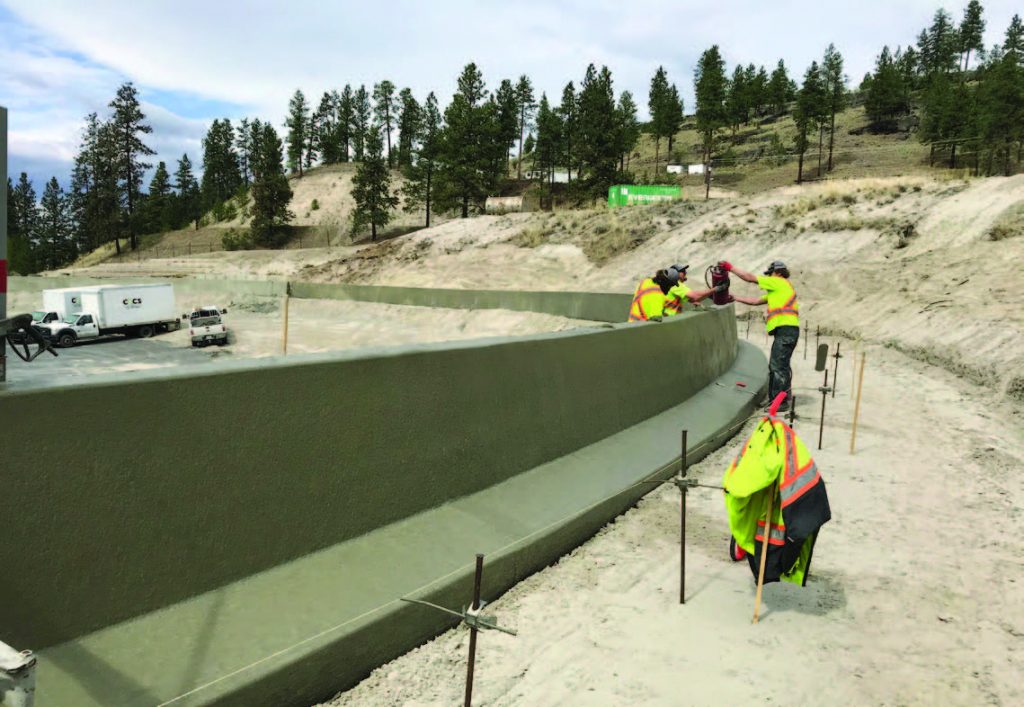
Dan and his crew of nine have a lot of pride in the perimeter wall that they recently slipformed with the 5700-C at Penticton Speedway, a 52-year-old oval stockcar racetrack in the Okanagan Valley.
CICS slipformed the high-profile barrier for Lake Excavating Ltd. and its partners, who own the racetrack.
While the project was under way, there was a lot of honking of car and truck horns on the nearby local road, Dan says. “We kept hearing it and what it was, people kept stopping to take pictures of the wall being formed by machine, and cars were honking behind them. The ready-mix guys also took pictures. It was so cool to see how it’s done with a curb machine.”
The secret is using the proper tool, Dan says, and that was the Power Curber machine. The barrier is 48 inches (122cm) tall and 10 inches (25cm) across the top so that a metal safety fence could be installed on top of the concrete.
He says that the barrier has a wide 40-inch base (1m) in case of car impact. “The whole base was backfilled and buried up to 6 inches (15cm) to the top,” he says. A total of 42 inches (107cm) of the barrier was buried outside the track. “Having earth on the back side gave it more stability,” Dan says.
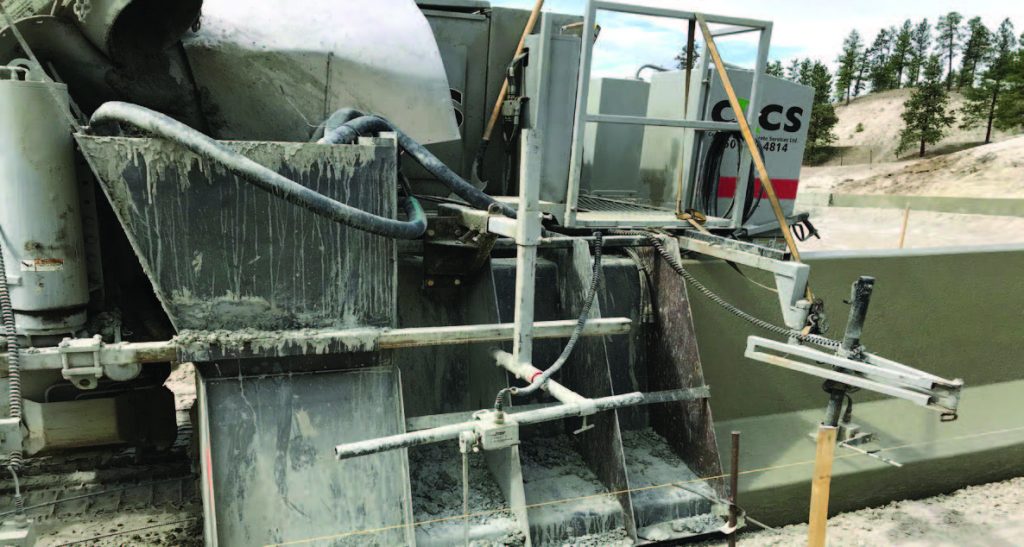
Dan says that the auger on the Power Curber 5700-C makes a world of difference. “In one tight spot, we could only get the ready-mix truck so close, so we filled the hopper with extra concrete,” he says. “Also, with curbing tight radius, we fill up the big hopper and auger and don’t have to re-position the truck multiple times. It saves time and reduces frustration.”
Slipforming the barrier was all about pricing and speed, Dan says, and the contractor is pleased. “Nobody can come in and put up barrier as fast as we can with the machine,” he adds. “We can do something in a week that would take a month by hand. There are substantial cost savings with the machine.”
It’s amazing how quickly I can get parts here. It’s good to know somebody has our back.
CICS also installed barrier at the Area 27 Speedway in Oliver, BC, a project with the same contractor, Lake Excavating Ltd, and its partners. The owner of Lake Excavating, Trevor Siebert, is also a professional race car driver and designer and owner of Avion Motor Sports. Dan says that Canadian stock car racing is a growing sport in British Columbia.
“The guys at the [Power Curbers] factory are happy to help,” says Dan. He is impressed with the service from the factory, located on the East Coast. “It’s amazing how quickly I can get parts here,” even with the three-hour difference. “It’s good to know somebody has our back,” he adds.
Dan has been “playing with concrete” for 32 years and started CICS in 2012, primarily doing fl at work. There was a need for curb and gutter in his small community, and he likes a challenge. He was doing maintenance for the City of Lake Williams, and the city scheduled a capital project and planned to hire a general contractor to bring in a curb-and-gutter machine from out of town.
“I wanted to see if I could do it,” he says about his first purchase of a slipform curb machine.
He bought his first Power Curber, a used 5700-Super-B, after owning a competitive slipformer and a Power Curber extruder. He found that the 5700-Super-B worked great. “We loved it for parking lots and liked how the mold went on,” he says. “It was a learning curve, but we had fun. In all fairness, the machine helps you out quite a lot.”
“The Power Curber is user-friendly,” he says. He finds the 5700-C that he now owns very versatile. “It has great access for viewing the product by the operator,” he says. “My operator loves it.”
With the competitive machine’s belt conveyor instead of the Power Curber auger, the consistency of the mix was a concern with low-slump concrete. “The Power Curber auger always gets the material to the mold,” Dan says. “If there is water running into the auger, the auger mixes it up, so you don’t have a wet spot in the finished product. You’d have a hard time with the conveyor.”
Without many curb-and-gutter machines in British Columbia, CICS is on the road a lot, traveling as much as nine hours for jobs and sometimes into Alberta. Transporting the machine is no problem, Dan says.
“I’d like to give Power Curbers a pat on the back for making this machine,” Dan says. “I like these unique jobs. Use your imagination, and the machine will help you.”
Customer feedback from Power Curbers Academy
“This was my first training school, and y'all set the bar VERY high”
“Very nice, top-notch facility”
“I have been to another service school many times... and this is better”
“I was impressed by the knowledge of the instructors”
“Good environment, great people, and good response to participation.”
“10/10. Perfect. Great.”
“Experience and knowledge of instructors makes everything much easier to understand. Invaluable info!”
“I feel you guys do a great job with these classes. This is my second time here and I will be back again! Thanks guys!”